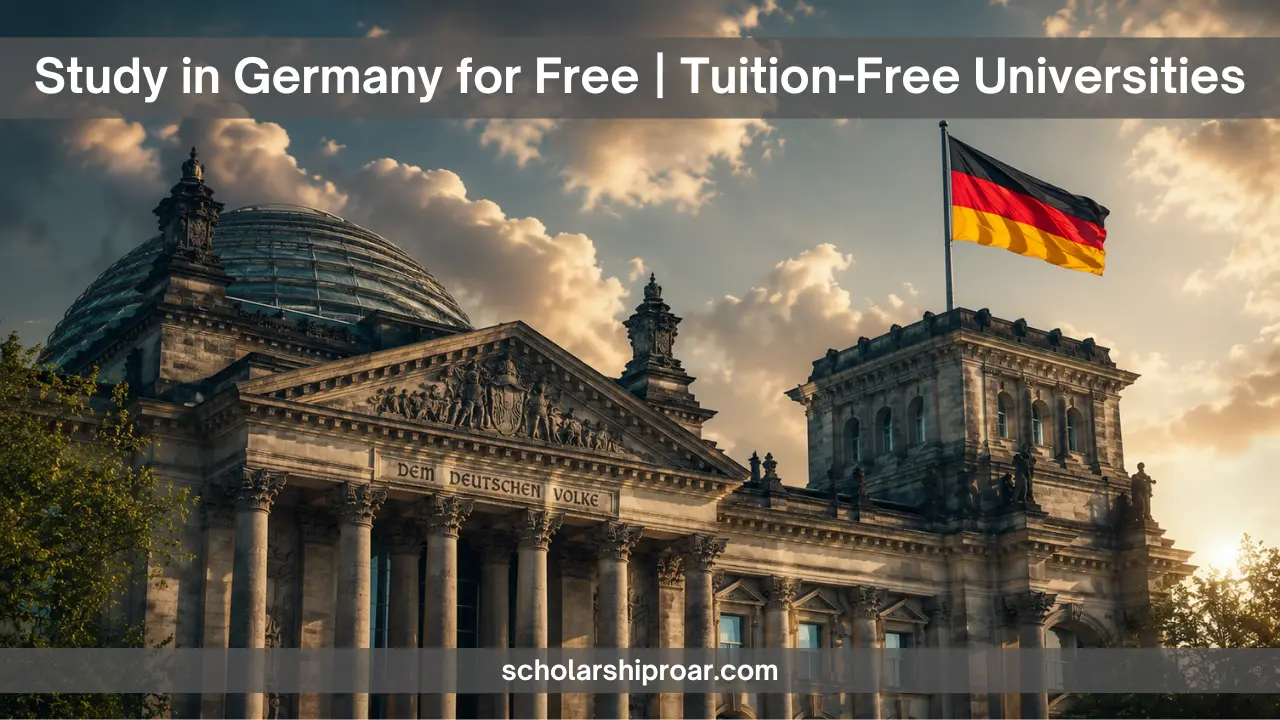
You really can study in Germany for free, and it is not a trick of wording: public universities in 14 of Germany’s 16 states charge no tuition to anyone, including international students from anywhere in the world, at bachelor’s and most master’s levels. Germany treats higher education as a public good, funds it through taxes, and extends that deal to foreigners on purpose, because it wants graduates who stay and work. In this article, we have explained which universities are genuinely tuition-free in 2027, the two exceptions everyone should know before choosing a city, what “free” still costs you in practice, and how to apply step by step.
The honesty most articles skip: free tuition does not mean a free life. You will pay a small semester contribution, you must show serious savings for the visa, and two regions now charge non-EU students real fees. All of it is below, with numbers.
Related Guides
- DAAD Scholarship
- Germany Scholarships for International Students
- Scholarships Without IELTS
- Erasmus Mundus Scholarship
Why German Universities Are Free, and for Whom
Germany abolished general tuition fees in 2014 after years of student protests, and the policy has held ever since. State governments fund the universities, and the free deal covers bachelor’s degrees and consecutive master’s degrees, meaning a master’s that follows on from your bachelor’s field. Doctoral study is free too, and PhD researchers are often paid employees rather than fee-paying students. Germany’s official portal for international students, Study in Germany, is run by DAAD and confirms all of this from the source.
Where fees still exist: non-consecutive programs like executive MBAs charge even at public universities, a second undergraduate degree can cost €500 to €650 a semester in some states, and private universities charge €5,000 to €20,000 a year, which is why almost every international student on a budget targets the public system.
The Two Exceptions to Check Before Picking a City
Baden-Württemberg charges non-EU students €1,500 per semester. This has been true since 2017 and, despite announced plans to scrap it, the fee is still being charged in 2026. It covers every public university in the state, which unfortunately includes some famous names: Heidelberg, KIT in Karlsruhe, Stuttgart, Freiburg, Mannheim, and Tübingen. There is a small mercy written into the state law: universities may exempt up to 5% of their international students, though the quota is tiny and the criteria strict, so do not plan around it. At €3,000 a year, “BaWü” is still far cheaper than the UK or USA, but it is not free.
TUM in Munich now charges non-EU students. Bavaria gave its universities permission to charge in 2023, and so far exactly one has used it: the Technical University of Munich, from winter 2024/25, at roughly €2,000 to €3,000 per semester for bachelor’s and €4,000 to €6,000 per semester for master’s programs, with a handful of programs still exempt. The twist worth knowing: LMU Munich, an equally strong university in the same city, charges nothing beyond the semester contribution. Same rent, same city, several thousand euros of difference a year.
Everywhere else, from Berlin to Aachen to Dresden, the tuition line on your budget is zero.
What “Free” Actually Costs
| Cost | Amount |
|---|---|
| Tuition (14 of 16 states) | €0 |
| Semester contribution | €100–400 per semester |
| Blocked account for the visa | €11,904 for 2026 (€992/month) |
| Health insurance | About €110–130 per month |
| Rent | €300–700 per month by city |
The semester contribution is not tuition. It is an administrative fee that usually includes a regional public transport ticket, which alone can be worth the money.
The blocked account (Sperrkonto) is the number that surprises people. Germany will not issue a student visa unless you deposit a year of living costs, €11,904 as of 2026, into a special account that then pays you back €992 a month. You are not spending it on the university; you are proving to the embassy that you can feed yourself. Providers like Fintiba and Coracle open these accounts online, and the amount rises most years, so check the current figure on the Federal Foreign Office pages when you apply.
The softener: students may work 140 full days a year alongside their studies, and at Germany’s minimum wage a normal part-time job covers groceries and transport comfortably.
Tuition-Free Universities Worth Targeting
Every public university outside Baden-Württemberg and TUM qualifies, which is over 250 institutions, so treat this as a starting shortlist rather than a ranking:
- RWTH Aachen — Germany’s engineering powerhouse, deep industry ties, zero tuition
- LMU Munich — top-tier research university, strong in medicine, law, and sciences
- TU Berlin, FU Berlin, and Humboldt — three strong universities in the country’s cheapest big-city rental market after the eastern cities
- TU Darmstadt — computer science and engineering, close to Frankfurt
- TU Dresden and Leipzig — excellent universities in the cities where your €992 a month stretches furthest
- Göttingen, Hamburg, Cologne, Münster — broad, well-ranked, and free
Pick by program and rent, not by fame. A free degree in Dresden with €350 rent is a different financial life from the same subject in Munich at €700.
The Language Question
Most bachelor’s programs are taught in German and require proof at TestDaF level 4 or DSH-2, which realistically means a year or more of serious language learning before you apply. At master’s level the picture changes: hundreds of English-taught programs exist, especially in engineering, computer science, and economics, and you can filter them all in the official DAAD program database. For English-taught programs, universities set their own English proof rules, and a fair number accept alternatives to IELTS, which we cover in our scholarships without IELTS guide.
Even in an English-taught program, learn German anyway. Your part-time job options, your internships, and your odds of staying after graduation all improve with it.
How to Apply, Step by Step
- Find your program in the DAAD database, filtering by subject, degree, and language of instruction. Check whether your school-leaving certificate qualifies you directly or requires a foundation year (Studienkolleg).
- Check the application route. Many universities take international applications through uni-assist, a central clearing service, while others run their own portals. Master’s applicants often apply to the university directly.
- Apply by the deadline: usually 15 July for the winter semester and 15 January for summer, though universities vary and popular master’s programs close earlier.
- Once admitted, open your blocked account, sort health insurance, and book the visa appointment at the German embassy early, because appointment queues in many countries run to months.
- After arrival, register your address, enroll in person, and validate your semester ticket. Then enjoy paying €0 in tuition while your friends abroad pay thousands.
Scholarships on Top of Free Tuition
Free tuition solves half the budget; scholarships solve the other half. The DAAD scholarships pay master’s students €992 a month, which exactly matches the official living cost, and doctoral candidates €1,400. The Deutschlandstipendium adds €300 a month based on merit at participating universities, and Erasmus Mundus programs with German partner universities pay €1,400 a month. Our full list of Germany scholarships for international students covers the rest.
Frequently Asked Questions
Is studying in Germany really free for international students?
At public universities in 14 of 16 states, yes, at bachelor’s and consecutive master’s level, with only a €100–400 semester contribution. The exceptions are Baden-Württemberg, which charges non-EU students €1,500 per semester, and TUM in Munich, which introduced fees for non-EU students from winter 2024/25.
Which German universities are completely tuition-free?
Every public university outside Baden-Württemberg, except TUM. That includes RWTH Aachen, LMU Munich, the Berlin universities, TU Darmstadt, TU Dresden, Hamburg, Göttingen, and more than two hundred others.
How much money do I need to show for the German student visa?
€11,904 for 2026, deposited in a blocked account before your visa application. It is released back to you at €992 a month for living costs. The figure is adjusted most years, so confirm the current amount when you apply.
Can I study in Germany in English?
At master’s level, widely: hundreds of English-taught programs run in engineering, IT, economics, and the sciences, all searchable on the DAAD database. At bachelor’s level, English-taught options exist but are fewer, and most undergraduate study still requires German at TestDaF 4 or DSH-2.
Can I work while studying in Germany?
Yes, up to 140 full days or 280 half days a year. At the current minimum wage, a standard part-time job covers a meaningful share of monthly costs, and university research-assistant jobs pay while building your CV.
Can I stay in Germany after graduating?
Yes. Graduates of German universities can get an 18-month residence permit to find a job matching their qualification, and Germany’s demand for engineers, IT specialists, and healthcare workers makes that transition realistic, especially with working German.