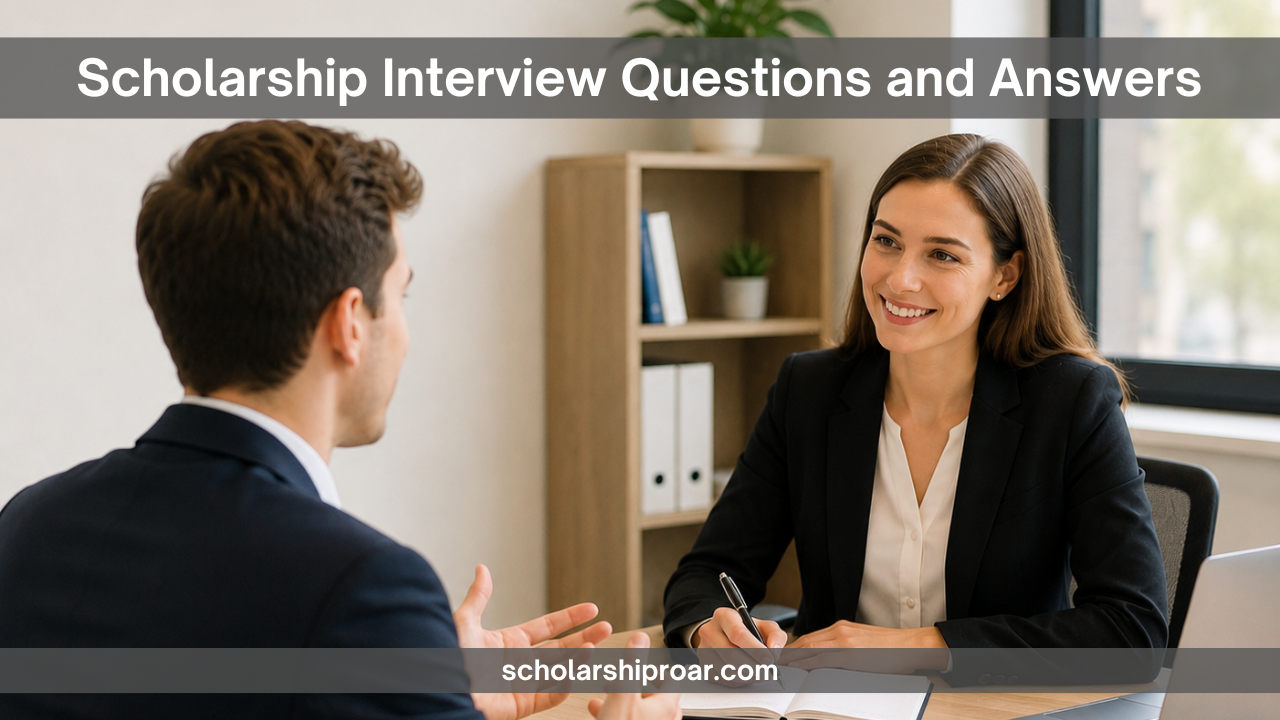
If you have been invited to a scholarship interview, the hard part is already behind you. Panels only interview candidates whose applications survived the first cut, which means your grades and documents have done their job. The interview decides something different, and most scholarship interview questions and answers guides miss it: the panel is no longer asking whether you are qualified. They are asking whether you are the person your application claims you are, and whether their money will do what the scholarship exists to do. In this article, we have explained the questions that come up in almost every scholarship interview, what each one is really testing, and how to build answers that sound like you instead of a script.
Interviews are standard at Chevening, Commonwealth, and Fulbright, and Nigerian applicants will face them at PTDF and NLNG too. The formats differ, but the questions barely do.
Related Guides
- How to Write a Statement of Purpose
- How to Write an Academic CV
- How to Request Strong Recommendation Letters
- Fully Funded Scholarships for International Students
What the Panel Is Actually Deciding
Three things, usually. Whether your story holds up when you cannot edit it. Whether you have a plan the scholarship can take credit for. And whether you will finish, because a scholar who drops out is a wasted award and someone on that panel will be asked about it.
Read your own application again before anything else. Panels build their questions from your file, and the fastest way to sink an interview is to contradict your own statement of purpose. If you wrote that you want to work in renewable energy policy, do not discover a passion for banking in the interview.
The Questions, and What Each One Is Really Asking
“Tell us about yourself.”
Not an invitation to recite your CV, which they are holding. This is the panel handing you two minutes to frame the whole conversation. Pick the two or three things you want the interview to be about and lead with them: where you are from, the problem or field that pulls you, and the one achievement that proves you act on it. Stop talking after two minutes. A focused short answer beats a complete long one every time.
“Why do you want this scholarship?”
The trap here is answering about money. They know you need funding; everyone applying does. What they are testing is whether you understand what makes their scholarship different from a bank transfer. Chevening wants future leaders connected to the UK. Commonwealth wants development impact in your home country. Fulbright wants cultural exchange in both directions. PTDF wants capacity for Nigeria’s energy industry. Answer with the mission, then connect your plans to it. If you cannot say what the scholarship is for beyond tuition, you are not ready for this question.
“Why this course, and why this university?”
Specifics win. Name the modules that match your goal, the professor whose work you want to learn from, the lab or centre the university is known for. “It is a world-class university” tells the panel you picked from a ranking. “The energy systems track includes grid integration, which is exactly the gap in my experience” tells them you did the work.
“What will you do after the scholarship?”
For government scholarships, this is the most important question in the room, and it is where most rejections happen. Chevening, Commonwealth, and Fulbright all fund people to go home and build something, and each has rules about returning. A vague “I hope to contribute to my country” fails. A plan succeeds: the sector you will enter, the kind of role, the problem you will work on, and why the degree makes it possible. A Nigerian engineer interviewing for Chevening might say she is returning to the power sector, targeting the distribution companies where losses are highest, because her MSc in energy systems covers exactly the smart-metering approaches those companies are starting to adopt. That answer is checkable, specific, and gives the panel a story to fund.
Do not hint that you plan to stay abroad. Even at interviews where nobody says it aloud, this is the question underneath the question.
“Tell us about a time you led something” or “describe a challenge you overcame.”
Have three stories prepared before the interview, drawn from work, study, or community life, each with a situation, what you specifically did, and what changed because of it. The structure matters less than the ownership: panels hear a lot of “we” and want to know what you did. Small, true, and specific beats grand and vague. Reviving a failing student society is a better story than a title you held and did nothing with.
“What is your weakness?” or “Tell us about a failure.”
Nobody believes “I work too hard.” The panel is testing self-awareness, so give them a real one, kept professional, with what you have done about it. A genuine answer sounds like: public speaking used to wreck me, so I volunteered to present at every team meeting until it stopped being frightening. Failure questions work the same way: pick a real failure, own your part in it without blaming others, and land on what it changed in how you work.
“Why should we choose you over other candidates?”
You will never know the other candidates, so do not compare. Restate your three strongest cards, tie them to the scholarship’s mission, and stop. Confidence here is not volume; it is precision. If your whole interview has been specific, this answer writes itself.
For PhD and research applicants: expect your proposal to be challenged.
Someone on the panel will poke at your methodology, your sample, or your timeline, sometimes deliberately harder than the flaw deserves. They are not telling you the proposal is bad. They are checking whether you can defend your thinking without getting defensive. Concede genuine weaknesses (“that is a fair limit, and here is how I would work within it”) and hold your ground on choices you made for a reason.
“Do you have any questions for us?”
Never say no. This is a free chance to sound like a future colleague instead of an applicant. Ask something you actually want to know: how scholars stay connected to the programme after graduating, what past scholars in your field went on to do, how the first months are structured. Do not ask anything answered on the website, and do not ask about money.
Preparing Without Sounding Rehearsed
Memorized scripts fail in the first thirty seconds, because a panel that hears recitation starts interrupting to find the real person. Prepare structures, not scripts: know your three stories, your after-plans, and your reasons cold, then let the sentences form fresh each time.
Do at least one full mock interview out loud with someone who will interrupt you. Answering in your head is not preparation; the words behave differently when they have to leave your mouth. Record yourself once, suffer through watching it, and you will fix more in an hour than a week of silent revision.
For online interviews, which Chevening and many others use, handle the boring things early: test your connection and camera the day before, sit facing a light source, look at the lens when you speak, and keep your application open on paper beside you rather than on the screen, where your eyes will drift. Log in ten minutes early. If your internet is unreliable, say so at the start and agree what happens if the call drops, because handling that calmly is itself a good answer.
Mistakes That End Interviews
- Contradicting your own application, the panel’s favourite thing to catch
- Answering “why this scholarship” with your financial situation
- Vague after-plans, or any hint that returning home is negotiable when the scholarship requires it
- Criticising your current employer, university, or country to seem motivated to leave
- Reciting memorized answers at speed instead of talking to the humans in front of you
- Going long: if an answer passes two minutes, you have stopped answering and started lecturing
Frequently Asked Questions
How long is a typical scholarship interview?
Usually 20 to 45 minutes. Chevening interviews often run 30 to 60 minutes with a panel of three or more. Whatever the length, the first two minutes and the after-plans question decide most of the impression, so weight your preparation there.
What should I wear to a scholarship interview?
Business or smart business-casual, including online. Overdressing has never cost anyone a scholarship; the reverse is not true. Online, dress fully, not just above the waist, because standing up mid-call happens.
How do I answer if I do not know the answer?
Say so, briefly, and reason aloud about how you would find out or approach it. Panels ask unanswerable questions on purpose sometimes. A calm “I do not know, but here is how I would think about it” scores better than confident nonsense, which experienced panels detect instantly.
Should I mention other scholarships I applied for?
If asked directly, be honest, because dishonesty discovered later can cost you an award you already won. Applying widely is normal, and panels know it. What matters is convincing them this one fits your plan, not that it is the only one you wanted.
How early should I start preparing?
A week of daily practice beats a month of occasional reading. Start when the shortlist email arrives: reread your application the first day, build your three stories and after-plan in the next two, and spend the rest on spoken practice.
Do all scholarships require interviews?
No. Many university awards decide on documents alone, and Erasmus Mundus programmes mostly rank written applications. Government scholarships like Chevening, Commonwealth, Fulbright, PTDF, and NLNG interview as a standard stage, so if those are your targets, assume an interview from the day you apply.